Pages

Showing posts with label Durga. Show all posts

Thursday, October 22, 2015

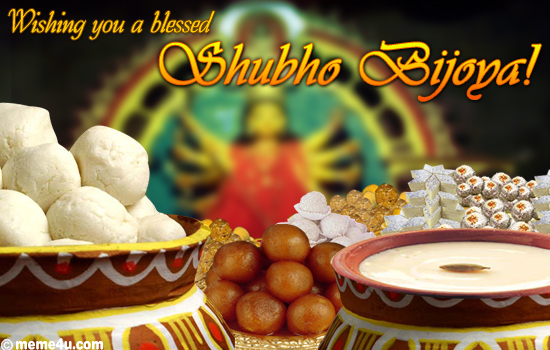
Vijaya Dashami / Dursherra - Shubho Bijoya

The air is full of grief. The daughter will be leaving the house.
Ladies line up to bid farewell to the goddess.
They feed the gods, and apply sindoor to the idols.

Then they will take a pinch of the same sindoor and apply it on other married bengali hindu women.This ritual owes its origins to the belief that the goddess is heading for her in-laws’ house and should be decked and fed properly. After all what will Her in-laws think.

The women prepare Dadhikarma. This is made from yogurt, milk, flattened rice, puffed rice, jaggery and batasha. This is given to Durga and then given to all. The Goddess has a long journey to take. She cannot go on a heavy stomach, but never in an empty stomach. So sweets, fruits and Dadhikarma. Books, pens are kept around the Goddess, such that the students can be blessed.
My mother would take a coin, give it to the Goddess, take a coin and keep it in her sindoor box. Then she would apply some of her sindoor to the Goddess and take some sindoor from the idol and mix it with her own sindoor.


Once the rituals of bidding the Goddess is done, the priests go around the Goddess.  The Goddess who had been invoked is now peacefully sent off to a long journey.

The priests then asks the people around to bid the mother farewell.

Darpan Visarjan is then performed. In a bowl of water, in which alta , kumkum and sindoor has been mixed and a mirror is kept, Durga's reflection is captured. Amidst chanting of mantras, Durga is bed farewell.


In the air , people shout BOLO DURGA MAI KI - JAI.

Now a patient wait for the next year when the Goddess will come visiting again.

In the evening the Image of Durga along with Navapatrika is taken in procession to the river bank and immersed in the river.  The water taken from the spot, known as Shanti Jal is sprinkled on the devotees who embrace one another as an expression of their solidarity as children of the same Divine Mother.


 The younger people touch the feet (Pronam) of their elders for their blessings and the men of same age do Kolakuli(hugging each other in a particular way). A time to visit close relatives and friends to wish Subho Bijoya to them. And of course greet each other with platters of sweets.


In Delhi, evening had a different charm. After the immersion of the Goddess, it was time to see burning of Ravava.

Huge effigies of Ravana, his brother Kumbhakarna and son Meghnad would be built. A bamboo frame on which paper has been stuck and painted. And inside the frame would be fire crackers. At the end of the Ram Leela, a person playing Rama would say I will pierce your navel and kill you and shoot an arrow.


I was always surprised then how this was done. Rama's arrow would fall barely a foot away, but somehow Ravana would burn. Later I realized it was just symbolic and the effigies were already setup in a way that an electric spark close by, would cause them to burn.

Dasha Hara is a Sanskrit  word. It means removal of bad fate. Durga has won over the asuras. Rama has won over Ravana.

Victory of Good over Evil.


Wednesday, October 21, 2015

Nine forms of Durga worshipped during Navaratri - 09 Siddhidatri

Siddhidatri is the ninth form of Goddess. She is worshiped on the ninth day of Navaratri. Siddhidatri has supernatural healing powers. She has four arms and she is always in a blissful happy enchanting pose. She rides on the lion as her vehicle. She blesses all Gods, saints, yogis, tantrics and all devotees as a manifestation of the Mother Goddess. In ‘Devi Bhagvata Purana’ it is mentioned that Lord Shiva worshipped her and was blessed with all Siddhis (supernatural powers).

In the beginning of the universe Lord Rudra worshipped Adi-Parashakti for creation. It is believed that Goddess Adi-Parashakti had no form. The supreme Goddess of Power, Adi-Parashakti, appeared in the form of Siddhidatri from the left half of Lord Shiva. By her blessings, Shiva's half body became female and other half body male in the avatar of Ardhnarishvara.

Goddess Siddhidatri sits on Kamal and sometimes rides on a lion. She is depicted with four hands. She has Gada in the one right hand, Chakra in the other right hand, lotus flower in the one left hand and Shankh in the other left hand.

She is the Goddess who possesses and bestows all type of Siddhis to her devotees. Even Lord Shiva got all Siddhis by grace of Goddess Siddhidatri. She is worshiped by not only humans but also by Deva, Gandharva, Asura, Yaksha and Siddha. Shiva and Brahma are also worshiped on this day, along with the Devi.

On the last day of the Navratra, the temples of the goddesses are decorated beautifully to worship the nine forms of the goddess. Special Durga puja are performed in every home around the country. Kanya puja is performed on this day to get the blessings of the goddess. Goddess Durga created this manifestation to shower the sympathy and compassion on her devotees. Devas, sages and humans everyone worship her will full devotion and she showers her immense compassion on the devotee who worships her with pure heart. A huge crowd of devotees can be seen in the temples and religious places.

All human beings should revere Goddess Siddhidatri to achieve absolute perfection. Siddhi makes the person highly eminent and glorified. After obtaining Siddhi, human beings observe enhancement in their charisma. And this is only possible if one pays heartily adherence toward Goddess Siddhidatri.


Tuesday, October 20, 2015

108 Names of Durga - Transliteration and Translation

This is from the Markandeya Purana (part of the Durga SaptaSahti) where Shiva is telling Parvati about the 108 names


  • shatanAma pravaxyAmi shR^iNushhva kamalAnane .

yasya prasAdamAtreNa durgA prItA bhavet.h satI

Lord Shiva speaks : O Parvati, Lotus Eyes one, I will now tell  You those one-hundred and eight names, by the means of which Durga  can be pleased.


  • OM satI sAdhvI bhavaprItA bhavAnI bhavamochanI .
  • AryA durgA jayA chAdyA trinetrA shUladhAriNI


(Salutaions - OM)
1) Sati, the daughter of Dakṣa;
2) Sadhvi, the Optimistic One;
3) Bhavaprita, loved by the universe; Also beloved of Shiva
4) Bhavani, the abode of the universe;
5) Bhavamocani, the reliever of the universe (she will relieve you from the ties of the universe);

6) Arya the noble;
7) Durga slayer of Durgamasura;
8) Jaya the victorious;
9) Adya, the beginning;
10) Trinetra, having three-eyes;
11) Suladharini, holding a spear;


  • pinAkadhAriNI chitrA chaNDaghaNTA mahAtapAH .
  • mano buddhiraha.nkArA chittarUpA chitA chitiH


12) Pinakadharini, Who holds the bow of Siva;
13) Citra  Beautiful (like a picture);
14) Chandraghanta, One who makes a mighty sound with bells;
15) Mahatapa, One can do severe penance;
16) Manas, power of mind;
17) Buddhi, power or knowledge of wisdom;
18) Ahankara, pride;
19) Cittarupa, thought-state;
20) Cita, death-bed;
21) Citi, the thinking mind (Chetana) ;


  • sarvamantramayI sattA satyAnanda svarUpiNI .
  • anantA bhAvinI bhAvyA bhavyAbhavyA sadAgatiH ..


22) Sarvamantramayi, possessing all the instruments of thought;
23) Satta, above all;
24) Satyanandasvarupiṇi, eternal bliss;
25) Ananta, infinite or beyond measure;
26) Bhavini, beautiful  creator of all
27) Bhaavya, Grand, One who is worth praising
28) Bhavya, Well wisher of all;
29) Abhavya, None one more well wisher than her;
30) Sadagati, always bestowing Mokṣa;


  • shAmbhavI devamAtA cha chintA ratnapriyA sadA .
  • sarvavidyA daxakanyA daxayaGYavinAshinI .. 5..


31) Sambhavi, consort of Sambhu or Shiva;
32) Devamata Mother of all Gods and Goddesses;
33) Cinta, thoughts;
34) Ratnapriya, adorned or loved by jewels;
35) Sarvavidya, abode of knowledge;
36) Dakshakanya, that is Sati, daughter of Dakṣa;
37) DakṣayajñavinaSini, destroyer of the sacrifice of Dakṣa;


  • aparNAnekavarNA cha pATalA pATalAvatI .
  • paTTAmbara parIdhAnA kalamaJNjIraraJNjinI ..


38) Aparṇa One who has given up on leaves while fasting;
39) Anekavarṇa, having many complexions (for example: Kali, Gauri);
40) Paṭala, red in color; (This in Sanskrit is Pa T La - T as in Tomato)
41) Paṭalavati, wearing red flowers;
42) Paṭṭambaraparidhana, wearing a dress made of silk;
43) Kalamañjirarañjini, wearing a melodious anklet she enjoys the melodious sound that comes;


  • ameyavikramA krurA sundarI surasundarI .
  • vanadurgA cha mAtaN^gI mataN^gamunipUjitA ..


44) Ameya, immeasurable;
45) Vikrama, fierce;
46) Krura, cruel (on demons);
47) Sundari Beautiful;
48) Surasundari Beautiful Goddess (assuming here Sura means Gods);
49) Vanadurga Goddess of the forests;
50) Matangi  Matangi is  considered to be the Tantric form of Saraswati and governs speech, music, knowledge and the arts. Her worship is prescribed to acquire supernatural powers, especially gaining control over enemies, attracting people to oneself, acquiring mastery over the arts and gaining supreme knowledge.;
51) Matangamunipujita, prayed by Sage Matanga;


  • brAhmI mAheshvarI chaindrI kaumArI vaishhNavI tathA .
  • chAmuNDA chaiva vArAhI laxmIshcha purushhAkR^itiH ..


52) Brahmi Power of Brahma;
53) MaheSvari Power of Mahesh (Shiva);
54) Aindri Power of Indra;
55) Kaumari Maiden;
56) Vaiṣṇavi Power of Vishnu
57) Camuṇḍa Slayer of demons Chanda and Munda;
58) Varahi - The female power of Varaha (form of Vishnu), upholder of life;
59) Lakṣmi  Goddess of Wealth;
 60) Puruṣakṛti, One who can take the form of a man;


  • vimalotkarshhiNI GYAnA kriyA nityA cha buddhidA .
  • bahulA bahulapremA sarvavAhana vAhanA ...


61) Vimalotkarṣiṇi, providing joy;
62) Jñana Knowledge ;
63) Kriya Action;
64) Nitya, eternal one;
65) Buddhida, bestower of wisdom;
66) Bahula, numerous in forms;
67) Bahulaprema, generously benevolent , loved by all;
68) Sarvavahanavahana, sits or rides all vehicles;


  • nishumbhashumbhahananI mahishhAsuramardinI .
  • madhukaiTabhahantrI cha chaNDamuNDavinAshinI ..


69) NishumbhaShumbhaHanani Slayer of the demon-brothers Shumbha Nishumbha
70) MahishasuraMardini  Slayer of the buffalo demon Mahishaasura
71) MadhuKaitabhaHantri Slayer of the demons Madhu and Kaitabha
72) ChandaMundaVinashini  Destroyer of the ferocious asuras Chanda and Munda


  • sarvAsuravinAshA cha sarvadAnavaghAtinI .
  • sarvashAstramayI satyA sarvAstradhAriNI tathA ..


73) SarvasuravinaSa, destroyer of all demons;
74) Sarvadanavaghatini, causes injury to all the demons;
75) SarvaSastramayi, deft in all theories;
76) Satya; The truth
77) Sarvastradhariṇi, possessor of all  weapons;


  • anekashastrahastA cha anekAstrasya dhAriNI .
  • kumArI chaikakanyA cha kaishorI yuvatI yatiH ...


78) AnekaSastrahasta, possessor of weapons in many hands;
79) Anekastrasya Dhariṇi, possessor of many weapons;
80) Kumari Virgin;
81) Ekakanya The girl child;
82) KaiSori; Young Girl
83) Yuvati Woman;
84) Yati; One has who has given up all


  • aprauDhA chaiva prauDhA cha vR^iddhamAtA balapradA .
  • mahodarI muktakeshI ghorarUpA mahAbalA ....


85) Aprauḍha, who never gets old;
86) Prauḍha, who is old;
87) Vṛddhamata, Old mother, with age comes knowledge - also a mother will all knowledge;
88) Balaprada, bestower of strength;
89) Mahodari, gigantic abdomen which stores the universe;
90) MuktakeSa, having flowing long hair;
91) Ghorarupa, having a fierce look;
92) Mahabala, having immense strength;


  • agnijvAlA raudramukhI kAlarAtristapasvinI .
  • nArAyaNI bhadrakAlI vishhNumAyA jalodarI


93) Agnijvala, glowing like fire;
94) Raudramukhi, having a fierce face like  Rudra (destroyer);
95) Kalaratri Dark like the night;;
96) Tapasvini Engaged in meditation;
97) Narayaṇi Destructive female force of Narayana or Vishnu;
98) Bhadrakali The letter 'Bha' means 'delusion' or 'Maya' in Devanagiri and 'dra' is used as a superlative i.e. meaning 'the most/the greatest e.t.c' which makes the meaning of Bhadra as Maha Maya
99) Viṣṇumaya Spell of Vishnu;
100) Jalodari, abode of the universe;


  • shivadUtI karAlI cha anantA parameshvarI .
  • kAtyAyanI cha sAvitrI pratyaxA brahmavAdinI


101) Sivaduti Messenger of Shiva;
102) Karali, fierce;
103) Ananta, immeasurable;
104) ParameSvari Beloved Goddess of all;
102) Katyayani One who was worshiped by Katyana;
106) Savitri From the Sun (Savitra), Gayatri;
107) Pratyakṣa  One who is real;
108) Brahmavadini.. Present everywhere


  • ya idaM prapaThennityaM durgAnAmashatAshhTakam.h .
  • nAsAdhyaM vidyate devi trishhu lokeshhu pArvati ..


Parvati, All those who daily read these 108 names from Durga Stotra, find nothing impossible in the three worlds.


  • dhanaM dhAnyaM sutaM jAyAM hayaM hastinameva cha .
  • chaturvargaM tathA chAnte labhenmuktiM cha shAshvatIm.h ..


Parvati, they receive benefits like  wealth (Dhana),  luxury (Dhanya), offspring (Suta) and wife (Jaya), horses and elephants (Haya Hasti), four things — dharma, artha, kaam, moksha, and in the end are liberated eternally.  .


  • kumArIM pUjayitvA tu dhyAtvA devIM sureshvarIm.h .
  • pUjayet.h parayA bhaktyA paThennAmashatAshhTakam.h ....


Having prayed and meditated upon Devi Kumari, and the Goddess of gods, Worship Her with devotion using this stotra.


  • tasya siddhirbhaved.h devi sarvaiH suravarairapi .
  • rAjAno dAsatAM yAnti rAjyashriyamavApnuyAt.h ....


O Goddess! The king who prays in the above manner attains perfection (siddhi), attains his kingdom, and splendor back from everyone including the gods. The kings become her slaves and attain their kingdom (Rajya) and Lakshmi or Wealth (Sri).


  • gorochanAlaktakakuN^kumeva sindhUrakarpUramadhutrayeNa .
  • vilikhya yantraM vidhinA vidhiGYo bhavet.h sadA dhArayate purAriH ..


Those who write a yantra (diagram) of this stotra with Gomutra ( cow's urine), Alta (a red color pigment used by women to colour their feet, could also be lacquer ), Kunkuma (Red herbal powder offered to the Goddess), Sindura (Red powder applied by women), Camphor, and Honey, and keep it in hand, becomes similar to Siva (attain salvation and are in eternal bliss).


  • bhaumAvAsyAnishAmagre chandre shatabhishhAM gate .
  • vilikhya prapaThet.h stotraM sa bhavet.h saMpadAM padam.h ..


The one who writes and recites this eulogy during the Bhauma Amavasya ,when Chandrma (Moon) is in Shatbhisha Nakshatra in the midnight ,attains every worldly luxury. According to hindu scriptures, amavasya that lies on Tuesday is known as Bhaumvati Amavasya. All kinds of pitra related activities are performed on this day. It is believed that the one who performs pitra daan and tarpan on Bhaumvati amavasya gets blessings from Pitra (departed ones).


  • iti shrI vishvasAratantre durgAshhTottarashatanAmastotraM samAptam.h


Thus ends the narration of the 108 names as mentioned in the Vishwa Tantra

Shodashopachara Puja of Durga

Shodashopachara (Sixteen fold worship)  is something I have been hearing a lot. It is an elaborate form of worship.


  1. Dhyana, Aavaahana: The first step is to invite the deity (Aavaahana)  and then we concentrate on the qualities of the deity - Dhyana. Avahana Mudra is formed by joining both palms and folding both thumbs inwards.
  2. Aasana : The deity is offered a mat to sit on.
  3. Paadya : Water is offered to wash the feet of the deity.
  4. Arghya : Water is offered to wash the hands of the deity.
  5. Aachamana : Taking three gulps of water.  By drinking water three times, the throat and other parts pertaining to speech faculty become smooth and the speech also becomes soft.
  6. Madhuparka : A drink made of honey , yogurt and clarified butter is offered to the deity.
  7. Snaana : The deity is then bathed with water, milk, yogurt and clarified butter.
  8. Vastra, Upaveeta : The deity is offered clothes to wear. Along with clothes, jewelry is also offered.
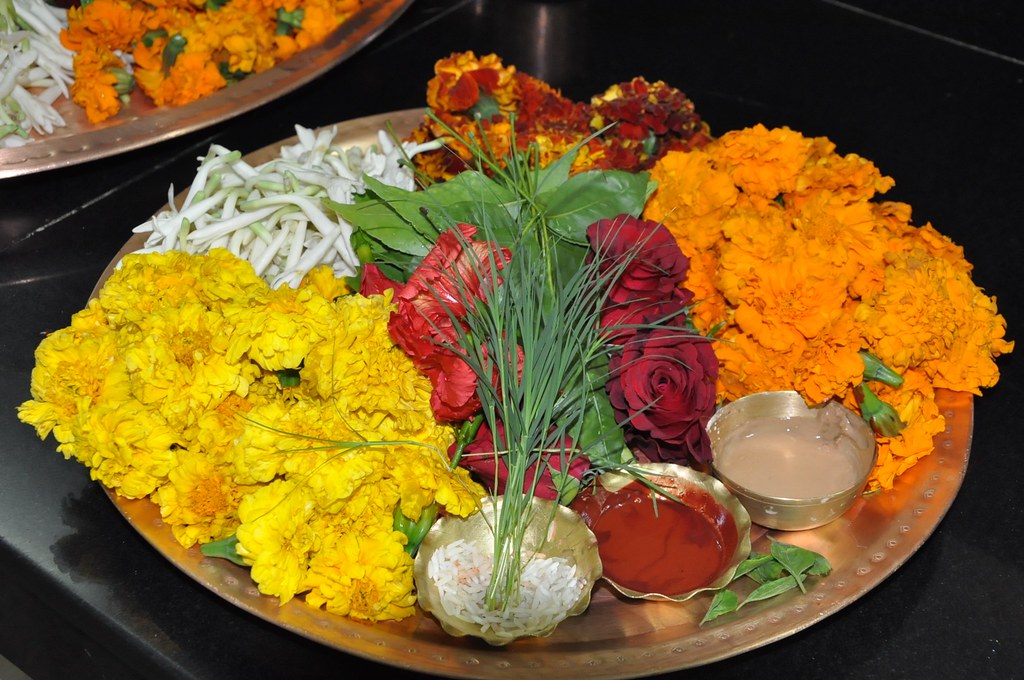
  9. Gandha : The deity is offered Kumkum which she will apply on her forehead. Kajal is offered for her eyes. Sandal wood paste is applied to the deity as perfume.She is then shown the mirror. She is then offered whole turmeric and unbroken rice.
  10. Pushpa : 108 or 1008 flowers are offered , while reciting the 108 or 1008 names of Durga as mentioned in the Devi Mahatmayam.  Along with flowers, Vilva leaves are also offered.
  11. Dhoopa : Coconut husks are lit, and on the smoldering husks resins from trees (dhuna) is added, and this along with incense sticks is offered.
  12. Deepa : Lamp lit with mustard or sesame oil is offered to the deity.
  13. Naivedya : Cooked bhog is offered. Food for Durga can be cooked by Brahmin men who have been initiated (had diksha). Along with this seasonal fruits are offered. Then a ripe coconut is offered to the Goddess.
  14. Taamblooa : 'Tamboola' means betel leaf. The deity is then offered betel leaf, as it will help the deity digest the food. Along with this money or gifts as Dakshina are offered. Books from which mantras will be chanted are also worshiped.
  15. Aarati : Oil lamps and burning camphor is shown to the goddess. 
  16. Mantrapushpa, Pradakshina :  Mantras are recited and by going round (pradakshina), we acknowledge the presence of the deity in all directions. After this the priest asks for forgiveness from the deity, for any rituals that may have been skipped or for any mistakes.


Durga Puja - Sashti and Saptami Pujas


During the nine days of Navaratri the book Chandi is recited everyday morning.  This recital is done along with worship of the Goddess Chandi.

Kalparambha, a ritual is done early in the morning of Sashti, sixth day.  It is mainly an act of making the samkalpa or ''sacramental intention'', the firm determination to conduct the Puja properly during the three days.  The ritual consists of installing the ghata, water-filled copper pot, at a corner of Durga mandap and offering worship to Durga and Chandi.

Durga is aroused. The mantra that is used, translates to 'On the Sixth of the evening I arouse thee'.
The arousing of the Goddess, the bodhana, is an evening ritual. As as per the rituals, it is said in the Bhrahmanda Nadikeshwara Purana, that Goddess Chandika resides in the wood apple or the Vilva tree on the sixth day. Prayers are offered to the Goddess and she is welcomed home, from the tree. The word ‘Bodhan' literally means ‘awakening'.  The Hindu mythology holds that all gods and goddesses go to sleep for six months during the southward journey of the Sun.  Autumn (Sharat), during which Durga Puja is done, falls in the middle of this period.  Hence it is necessary to first of all awaken the deity Durga. The awakening of Durga was first done by Sri Rama who wanted to propitiate the Goddess before fighting Ravana.

The ritual of Bodhan consists in installing a water-filled copper vessel at the base of the Bel (Bilva) tree  and praying to the Divine Mother to awaken.

Bodhan is followed by Adhivas.  Adhivas means ''invocation''.  Through Bodhan the Devi has awakened: now the awakened Devi has to be invoked in the Bel tree or branch of the tree.  Adhivas is also a ritual of sanctification.  The actual ritual consists of the following main steps.


  • Devi Durga and the Wood Apple tree are first worshipped
  • Twenty-six sacramental things (mangalik dravya) are sanctified by touching Devi Durga and the Bel tree with them. These include sari (cloth), kumkum, turmeric etc.
  • To ward off evil effects, a red coloured thread is tied around the altar where Puja is done.


On the sixth day only the Goddess enters the house. The navapatrika is yet to come in. Early morning, before sunrise, the navapatrika is bathed in the waters collected from different rivers. The navapatrika then enters the house. The scriptures say Navapatrika coming into the house in the early morning gives rise to health, wealth and victory. It is also said the navapatrika has to be brought in early morning inside the house. Any later, and the scriptures say, it brings about distress and destructiveness.

On Saptami, a living deity is required to invoke the Goddess. On the sixth day , Durga was invoked in the Bel tree or a branch of it.  On the seventh day the Deity is invoked in a group of nine plants known as Navapatrika.  The nine plants, which include a branch of Bel tree also, are bundled together, given a ceremonial bath, covered with an orange coloured cloth and installed on a wooden seat on the right side of the image of Durga, usually on the right side of Ganesha.  This is followed by Mahasnan (great bath) on a mirror, using various materials.  After this, consecration and divinization of the image, known as pranapratishtha, takes place.  This is followed by elaborate worship of the Devi with sixteen items (shodashopacharapuja).  The other deities, attendants and other objects associated with Devi are then worshipped.  The Seventh Day's Puja is concluded with bhog (food offering) and Arati to Devi.

Food offerings constitute of black sesame seeds, Hartaki (myrobalan), flowers, two earthen ware bowls brimming with raw rice (atop chaal), wood apple leaves,  white mustard, (40 or 22 bowls of madhuparka - a drink made with honey, yogurt and ghee (clarief butter), honey, raw sugar, 40 or 22 naivedhyas (cooked food), one main naivedhya (cooked dish) , fruits and items used to prepare the naivedhya.


For the puja one would need Jute ropes, red thread, alta (red liquid or lacquer) , four finger rings, four sacred threads, a pot, a mirror, a tekatha (a triangular frame made of wood), sandalwood, urad dal, hibiscus flower, small naivedya, one big earthen lamp, pancha pallava (five leaves), pancha ratna (five gems), pancha shashya (*five different grains) , five different colors, vermillion, items for arati, sand, wood,  cowdung, cow urine, kusha grass, ghee, 108 vilva leaves and a bowl.

After food and Puja, Cothes are offered to the Gods.

One needs Clothes for the priest, gamcha (towel), 40 or 22 finger rings made of kusha grass, sari for navapatrika, one sari for the main puja, saris for Durga, Lakshmi, Saraswati,  clothes for Kartikeya, Ganesha, Shiva, Vishnu, clothes for nine planets, clothes for peacock, mouse, lion, demon, buffalo, ox and snake. , Chandmala, a nosering, iron, conch shell are also needed and clothed. Each Chandmala usually comprises three disks, attached with strings and with hanging decorations at the end. Each disk usually has a golden or silver color rim.

Along with this, one needs flower garlands, garland made of vila leaves, Banana plant, turmeric plant, colacassia plant, wood apple stem, pomegranate stem, a stem of Jayanti plant, arum plant, rice plant, ashoka stem, twigs of white aparajita plant and two banana stems.

For the aarti one would need dhakis and dhaak.


Durga - Making the mother come to life

Nature is also celebrating Durga Puja. The Shiuli (I found out the botanical name also - -Nyctanthes arbor-tristis) flowers were lying on the grass. The dark green grass with dew, and the white flowers with that tinge of orange, lying there. A beautiful sight to see.


Evening when I go home, I am greeted by the heavenly aroma that comes from the flowers.

Ma Durga is here.

Here is how Ma Durga comes to life.


Kathamo  is the bamboo structure. The frame on which the idols of Durga will be made. The worshipping of Durga starts from the day of Rathayatra , actually Ulta Rath, in the month of July (approximately), when the bamboo structure is built and worshiped. Some people build it from scratch every year, but I have seen people also fish out the old kathamo after immersion, and rebuild on top of that.

Kumor or Potua is the artisan who builds the idols. He will go through prayers before he starts work. First, bamboo sticks are cut in different shapes so as to support the main statue of the Goddess and also to create a platform to place her idol. The artisan then painstakingly creates a clay figurine of the Goddess. This is the most difficult part.  Straw is bundled and tied around the frames using jute ropes. Traditions talks about using only paddy straw and freshly spun jute ropes. This is molded to give shape. Gradually the stricture forms. He usually will stick old newspapers on the bamboo structure. While one person or group of people are working on the structure, there will be another group or person, mixing the clay to give shape to the idols.


It is said that in Bengal, clay from the door of a prostitute has to mixed with the clay of Ganges and only then the idols will be made. The origin of the story is lost. It may have been used to include them as part of the celebrations. Some also say when men visited the prostitutes, they left their virtues at the door step and then went inside. It was collecting this pious clay is what brought about this. It is said , one cannot just go and take the clay. One has to beg for it, and only then it will be fruitful.


The first coat of clay used to make the image of the Goddess is watery. This helps fill up the gaps created by the straw structure. Another watery layer may be used again, if and only if that is needed. Overdoing will spoil the idol. The second layer is applied very carefully, since this is what actually gives shape to the idol. The mixed clay has to be pure and fine, so that there are no lumps and such while mixing. The palms, feet and head are all made separately and are then attached to the torso.

The face, which is the main part, is created with a great deal of effort. The artisans nowadays use existing molds. If being done for the first time, liquid Plaster of Paris is first poured over it, creating a mold. Then the mold is separated from the clay. The mold is then used to create many other similar heads.


Once the structures are assembled together, a final touch is added before the painting starts.
Cotton cloth soaked in fine clay, taken from the river bed of the Ganga, is applied to the joints of the figurines. This develops cracks while drying and essentially strengthens the joints. The image is then painted with white clay. If white clay is not available, lime and clay is mixed and applied on the idols. Once this dries, the statue is painted with pink or yellow earth colors. Traditionally vegetable and flowers would be crushed and mixed with the clay to form the necessary shade of color. This was then applied.  Once Durga, her children and the lion has been colored, the asura is colored in green or brown colors.


The fine detailing of the eyes is done by the main artist. A coat of varnish is applied to the idol and hair, made of jute, is pasted onto the idol's head and is then ornamented.
Traditionally Durga was draped in fabric cut to shape and bordered with brocade and silver threads. Nowadays many people donate clothes for the idols which are folded around.

The idols of the mother and now ready.


While making the idols/ kathamo, one hears a term Ekchala.

Ekchala is the idols in one frame, rather than building the idols separately in their frames and then placing them aside. Ekchala Durga is the traditional way of building the idols.


The Durga Chalchitra, also referred to as Devichal or Chali, is the painted background of the Durga idol. The newspapers that were stuck on the bamboo frame now get transformed.

There are four varieties of Chalchitra - Bangla Chal, Markini Chal, Mothchouri Chal and Tanachauri Chal.  Among the commonly seen chali is the Markini Chal. This comes in a semicircular shape, extending from one end of the idol to the other, propped up by two pillars. The Bangla chal follows the tradition of temple architecture. It stretches on both sides of the idol in a suspended pattern and is long enough to fit all the idols present there. Shiva is a vital part of Chalchitras. He is depicted in different postures and moods, such as playing a Vina, dancing, smoking ganja, riding the Nandi and even sleeping.

The lack of patronage has caused this wonderful art to fade away from mainstream art. Moreover, challis are usually immersed along with the idols and hence, no official legacy is found. Nowadays, the Chalchitra is used only as a part of decoration.

In older days when the length of the chalies were more, stories from Mahabharata and Ramayana, besides pictures of Das Maha Vidya of Durga, Nava Durga, Astha sakhi, Dashavatar of Vishnu etc. were painted.

Blue is used as a base with a few exceptions of pink ones. The figures are generally painted in reds. Other colours used are yellow, green, pink and black. In some occasions the chali used to be divided with dark margins like "Choukopots" having images like Narada, Narayana, Shiva, Indra Brahma. In some other region the figures are found to be floating.


Nine forms of Durga worshipped during Navaratri - 08 Maha Gauri

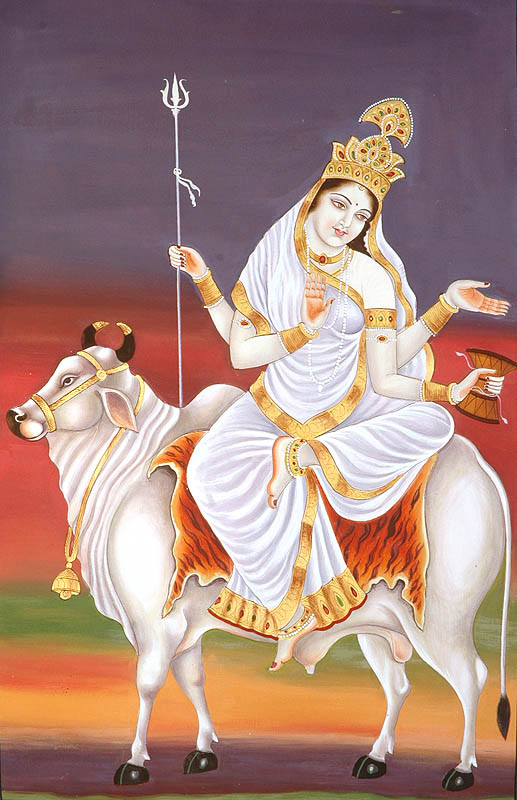
She is worshipped on the eighth day of Navaratri. Her power is unfailing and instantly fruitful. As a result of her worship, all sins of past, present and future get washed away and devotees get purified in all aspects of life. Maha Gauri is intelligent, peaceful and calm. Due to her long austerities in the deep forests of the Himalayas, she developed a dark complexion. When Lord Shiva cleaned her with the water of the Ganges, her body regained its beauty and she came to be known as Maha Gauri, which mean extremely white.

She wears white clothes, has four arms, and rides on a bull. Her right hand is in the pose of allaying fear and her right lower hand holds a trident. The left upper hand holds a ‘damaru’ (a small two headed drum) and the lower one is in the pose of granting boons to her devotees.

According to Hindu mythologies, the Goddess Shailputri at the age of sixteen was extremely beautiful and was blessed with fair complexion. Due to her extreme fair complexion she was known as Goddess Mahagauri. Due to her fair complexion Goddess Mahagauri is compared with the conch, the moon and the white flower of Kunda . She adorns white clothes only and due to that She is also known as Shwetambardhara.


Monday, October 19, 2015

Nine forms of Durga worshipped during Navaratri - 07 Kaal Ratri

This is the seventh form of Mother Durga and is worshipped on the seventh day of Navaratri. She has a dark complexion, disheveled hair and a fearlessness posture. A necklace flashing lightning adorns her neck. She has three eyes that shine bright and terrible flames emanate from her breath. Her vehicle is the donkey. Her raised right hand always seems to grant boons to all worshippers and all her right lower hand is in the pose of allaying fears.

What I have been trying to find out is why a donkey. What I could infer is, the donkey is a very stubborn animal. If it has made up its mind to do something, it will - irrespective of the consequences. Also the donkey may appear docile, but with its hooves, it can give away a strong kick. Are these the reasons for the vahana for Kalratri? No idea.

Her left upper hand holds a thorn-like weapon, made of iron and there is a dragger in the lower left hand. She is black like Goddess Kali and holds a sparkling sword in her right hand battle all evil. Her gesture of protection assures us of freedom from fear and troubles. So she is also known as ‘Shubhamkari’ – one who does good.

She is clad in loose red cloth to cover her upper body and wears tiger skin below her waist. Her whole body adorns various forms of thorny garlands, anklets, waist-bands, wrist-bands and armlets

Though the appearance of Maa Kalratri is dreadful, her grace is generous toward devotees. Worshiping Kalaratri on the seventh day gives abundant fruitful result. With her grace, devotees get power, position and eminent status on earth. She protects her devotees against evil influence of demons and wrong people. Worshiping her, devotees get complete protection and long life.

 No one could kill Raktabeej, as even one drop of his scattered blood was able to form another embodiment of Raktabeej. And that way, scattered blood of Raktabeej formed countless other  Raktabeej. Devi Durgai manifested herself in Kalaratri, and kept a Patra (vessel) to keep and imbibe entire blood of his body. Her extreme violent appearance while destroying Raktabeej and other demons hugely terrified all organisms of Universe. But still, she is a generous Goddess for her great devotees.

Another legend says that, once there was a demon named Durgasur who tried to attack Kailash, the abode of Parvati in the absence of Shiva. Parvati got to know about this and created Kaalratri and said her to go and warn Durgasur, when Kaalratri reached there Durgasur's guards tried to capture her but she grew big in her original form and said Durgasur that his death was nearby. After that when Durgasur came to invade Kailash, Parvati battled him and killed him gaining the name Durga. Here Kaalratri serves as an agent who gives the message and warning from Parvati to Durgasur.

During Navratri, Saptami Poojan of Devi Kalratri is considered as Maha Pooja or great worship of Goddess Durga. Delighting this deity, devotees certainly get enormous happiness, power and comforts in life. Maa Kalratri is Worshiped to destroy agony of awry influence from life of mankind. On the seventh day of Navratri Pooja, Saptami fast is observed to please this deity. Tantra-mantra practices are also performed and accomplished under blessings of this Goddess. Seventh day of Navratri pooja is envisaged as one of the great days in Durga Pooja. Worship Maa Kalaratri on the seventh day of Navratri Pooja and obtain her enormous grace.


Sunday, October 18, 2015

Nine forms of Durga worshipped during Navaratri - 06 Katyayani

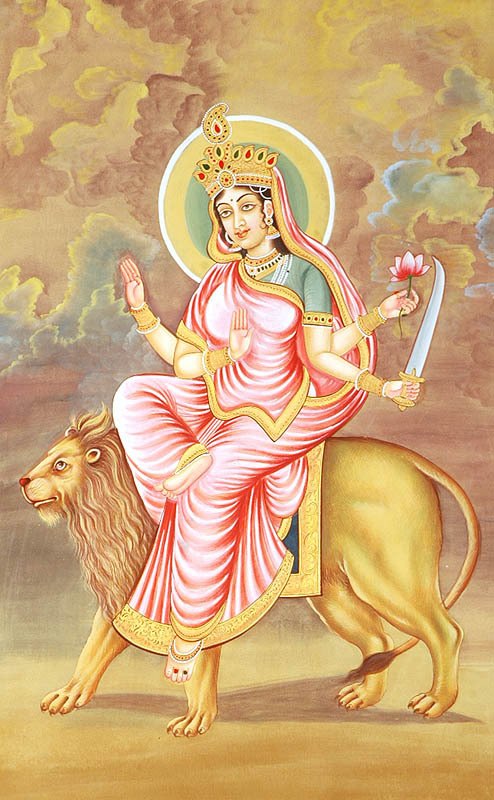
The sixth form of Mother Durga is known as ‘Katyayani’, who is worshipped on the six day of Navaratri. The legend behind her name goes thus: Once upon a time, there was a great sage called Kata, in whose lineage was born the sage Katyayan. Katayan was very famous and renowned in the lineage of saints. He underwent long austerities and penance in order to receive the grace of the Mother Goddess. He wished to have a daughter in the form of a goddess.

According to his wish and desire the Mother Goddess granted his request. His daughter was the Mother Durga reborn. As she was born in Katyayan's house, she was called Katyayani.
Goddess Katyayani rides on the magnificent lion and depicted with four hands. Goddess Katyayani carries lotus flower and sword in her left hands and keeps her right hands in Abhaya and Varada Mudras.

It is said that in this form Mahishasura was killed. This was form that created by the devas, who was eventually born in Katyayan's house and who came and killed Mahishasura.

Mother Katyayani a blesses you with better health and wealth. By worshipping  Katyayani, you may develop great strength to fight all disease, sorrows and fears. In order to destruct the sins accumulated over your several lives, you should religiously worship Katyayani.

This is the daughter form of Durga. Here is she a loving daughter. She is epitome of love but won’t hesitate to rise up in anger to defend righteousness and Dharma. It is believed that Maa Katyayani persistently battles against the evil and deceitful entities.

She is also referred to as the Goddess of Vrindavan. She was widely worshiped there by the Gopis.


Saturday, October 17, 2015

Nine forms of Durga worshipped during Navaratri - 05 Skandamata

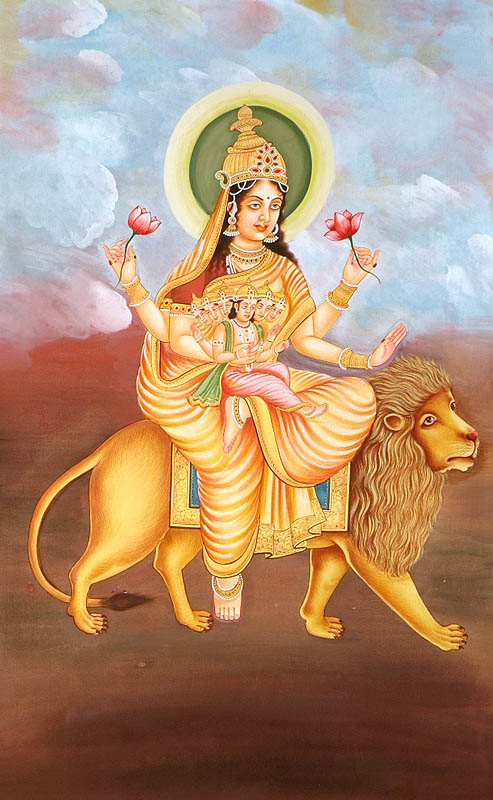
Skandamata is the fifth form of Goddess Durga.  Skanda is another for Kartikeya and Mata is the name of mother. Her worship takes place on the fifth day of Navaratri. She is accompanied by the Lord Skanda in his infant form. Skanda Mata has four arms and three eyes, holds the infant Skanda in her right upper arm and a lotus in her right hand which is slightly raised upwards. The left arm is in pose to grant boons with grace and in left lower hand which is raised also holds a lotus. She has a bright complexion and often depicted as seated on a lotus, because of that Skandamata is also known as Goddess Padmasana. Devotees who worship this form of Goddess Parvati get the benefit of worshipping Lord Kartikeya.


Friday, October 16, 2015

Nine forms of Durga worshipped during Navaratri - 04 Kushmanda

Kushmanda is the fourth form of the mother goddess and is worshipped on the fourth day of Navaratri. The meaning of the name ‘Ku-shm-anda’ is as follows: ‘Ku’ = a little; ‘ushma’ = ‘warmth’; ‘anda’ = ‘the cosmic egg’. So she is considered the creator of the universe. The universe was no more than a void full of darkness, until her light spreads in all directions like rays from the sun. Often she is depicted as having eight or ten hands.
She holds weapons, glitter, rosary, etc., in her hands, and she rides a tiger or a lion.

The glow and radiance of her body is as luminous as that of the Sun. It is believed that Goddess Kushmanda provides direction and energy to the Sun. Hence God Sun is governed by Goddess Kushmanda.

As per the Hindu mythology, Lord Vishnu was able to start creating the universe when Maa Kushmanda smiled like a flower which blossomed with a bud. She created the world from nothing, at the time when there was eternal darkness al around. This Swarup of Maa Durga is the source of all. Since she created the universe, she is called Adiswarup and Adishakti.

The Goddess also loves the sacrifice of a pumpkin. Hence, sacrificing pumpkin in front of the Goddess is a crucial ritual of the fourth day.

 It is advised that one should perform worship for this almighty only after absolute purification of heart and soul. Impure heart can make this Goddess infuriate. Grace of this Goddess finishes all types of physical and mental disorders and ailments. By spiritually worshiping Goddess Kushmanda, the worshiper can become free from afflictions. Her grace endows divine spark to adorers. Worshiping her in simple process, the worshiper can feel the existence of this great almighty. Goddess Kushmanda is true symbolism of divine spark. Worshipers of this Goddess certainly obtain cosmic energy that enhances their positive aura. Positive reflection makes the person glorified in society. With blessings of Devi Kushmanda, devotees can achieve name, fame and other comforts of life.


Thursday, October 15, 2015

Nine forms of Durga worshipped during Navaratri - 03 Chandraghanta

The third facet of Goddess Durga is ‘Chandraghanta’, who is worshipped on the third day of Navaratri, for peace, tranquility and prosperity in life. She has a ‘chandra’ or half moon in her forehead in the shape of a ‘ghanta’ or bell. That is why she is called ‘Chandraghanta’. She is charming, has a golden bright complexion and rides a tiger. She has ten hands, three eyes and holds weapons in her hands. She is the apostle of bravery and possesses great strength to fight in the battle against demons. One of her hands is in abhaya mudra where she is showering blessings on her devotees.

Goddess Chandraghanta is the married form of Goddess Parvati. After getting married to Lord Shiva , the Goddess started adorning on her forehead, the half moon and due to which Goddess Parvati was known as Goddess Chandraghanta. It is also said when Shiva had come to marry her with his followers who primarily ugly, horrible looking, the Goddess requested Shiva to appear as a charming prince. On seeing this beautiful form the Goddess, Shiva agreed.

This form of Durga is not completely different from earlier forms. It shows that when provoked she can be malevolent. Her malevolent form is said to be Chandi or Chamunda Devi. She is otherwise the very embodiment of serenity.

You need to follow simple rituals to worship Goddess Chandraghanta. You should first worship all the Gods, Goddesses and Planets (General prayers) and then offer prayer to Lord Ganesha and Kartikeya and Goddess Saraswati, Lakshmi, Vijaya, Jaya – the family members of Goddess Durga. The pooja should be concluded by worshipping Goddess Chandraghanta followed by a heartfelt prayer to Lord Shiva and Lord Brahma.


Wednesday, October 14, 2015

Nine forms of Durga worshipped during Navaratri - 02 Bhramacharini

She is worshipped on the second day of Navaratri and is the second form of Mother Goddess. Bharmacharini means one who practices devout austerity. She enlightens us in the magnificent embodiment of Durga with great powers and divine grace. She holds a rosary in her right hand and a Kamandal in her left hand. She is blissful and endows happiness, peace, prosperity and grace upon all devotees who worship her. She walks bare feet.
Filled with bliss and happiness, she is the way to emancipation - Moksha.

Goddess Parvati took birth at the home of Daksha Prajapati and was called Sati. It is said to win Shiva as her husband, this is the form in which Sati did her penance for Shiva. What I am not sure is, if it Sati that is being referred to, or is it Parvati's penance to win Shiva.


Tuesday, October 13, 2015

Nine forms of Durga worshipped during Navaratri - 01 Shailaputri

Shailaputri literally means the daughter (putri) of the mountains (shaila). Variously known as Sati Bhavani, Parvati or Hemavati, the daughter of Hemavana - the king of the Himalayas, she is the first among Navadurgas. Her worship takes place on the first day of Navaratri – the nine divine nights. The embodiment of the power of Brahma, Vishnu and Shiva, she rides a bull and carries a trident and a lotus in her two hands.

After the self-immolation in the form of Goddess Sati, Goddess Parvati took birth as the daughter of Lord Himalaya. In Sanskrit Shail means the mountain and due to which Goddess was known as Shailputri, the daughter of the mountain.
It is believed that the Moon, the provider of all fortunes, is governed by Goddess Shailputri and any bad effect of the Moon can be overcome by worshipping this form of Adi Shakti.
It is said that in this form, Parvati got married to Lord Shiva.


Durga Puja in Bengal

This is a bit cloudy to me. There is always a reason why a celebration happens. Tilak, for example , is supposed to have started Ganesha Festival in Maharashtra.
Thus, what was the catalyst to start the Autumn Durga Festival in Bengal?

If I believe what I had read long back, this dates back to the battle of Plassey or Palashi.

Clive had won a war. He wanted to pray to God. Alas, the church was destroyed in the war.


When Raja Nabakrishna Deb came to know of Clive’s desire, he invited the latter to his house at Durga Puja and offer his thanks at the feet of Goddess Durga. Initially Clive had some hesitations to attend the puja as in those days Christians were not allowed by the Hindus to take part in Hindu festivities. However, the mighty Nabakrishna Deb managed it all and Robert Clive paid a visit to the Shobhabazar Rajbari to offer his thanks to Goddess Durga. Thereafter, the Shobhabazar Durgotsab(Durga Puja ceremony) came to be known as the "Company Puja".

But was this the first Puja? Probably no.
Was this puja done for Clive? No idea.

Still searching for the answer.

Monday, October 12, 2015

Durga coming on a Horse Leaving on a Palanquin

When Mother Durga leaves Kailash to visit her parents during Durga Puja, she chooses a mode of transport or vehicle, apart from her lion.

If Durga Puja starts on a Sunday or a Monday, that signifies the mother is coming on an elephant.
If Durga Puja starts on a Saturday or a Tuesday, that signifies the mother is coming on a horse.
If Durga Puja starts on a Thursday or a Friday, that signifies the mother is coming in a palanquin.
If Durga Puja starts on a Wednesday, then she is coming on a boat.

This year the puja will start on 16th October 2015 which is a Tuesday. That signifies Horse.
Horse signifies going on a war. This is considered inauspicious and brings devastation. This could bring forth calamities.

This year Vijaya Dashami is on a Thursday, 22nd October. The Goddess will leave on a palanquin. Again leaving in a palanquin is sign of diseases, famine and natural calamities.