Pages

Showing posts with label Nine. Show all posts

Wednesday, October 21, 2015

Nine forms of Durga worshipped during Navaratri - 09 Siddhidatri

Siddhidatri is the ninth form of Goddess. She is worshiped on the ninth day of Navaratri. Siddhidatri has supernatural healing powers. She has four arms and she is always in a blissful happy enchanting pose. She rides on the lion as her vehicle. She blesses all Gods, saints, yogis, tantrics and all devotees as a manifestation of the Mother Goddess. In ‘Devi Bhagvata Purana’ it is mentioned that Lord Shiva worshipped her and was blessed with all Siddhis (supernatural powers).

In the beginning of the universe Lord Rudra worshipped Adi-Parashakti for creation. It is believed that Goddess Adi-Parashakti had no form. The supreme Goddess of Power, Adi-Parashakti, appeared in the form of Siddhidatri from the left half of Lord Shiva. By her blessings, Shiva's half body became female and other half body male in the avatar of Ardhnarishvara.

Goddess Siddhidatri sits on Kamal and sometimes rides on a lion. She is depicted with four hands. She has Gada in the one right hand, Chakra in the other right hand, lotus flower in the one left hand and Shankh in the other left hand.

She is the Goddess who possesses and bestows all type of Siddhis to her devotees. Even Lord Shiva got all Siddhis by grace of Goddess Siddhidatri. She is worshiped by not only humans but also by Deva, Gandharva, Asura, Yaksha and Siddha. Shiva and Brahma are also worshiped on this day, along with the Devi.

On the last day of the Navratra, the temples of the goddesses are decorated beautifully to worship the nine forms of the goddess. Special Durga puja are performed in every home around the country. Kanya puja is performed on this day to get the blessings of the goddess. Goddess Durga created this manifestation to shower the sympathy and compassion on her devotees. Devas, sages and humans everyone worship her will full devotion and she showers her immense compassion on the devotee who worships her with pure heart. A huge crowd of devotees can be seen in the temples and religious places.

All human beings should revere Goddess Siddhidatri to achieve absolute perfection. Siddhi makes the person highly eminent and glorified. After obtaining Siddhi, human beings observe enhancement in their charisma. And this is only possible if one pays heartily adherence toward Goddess Siddhidatri.


Tuesday, October 20, 2015

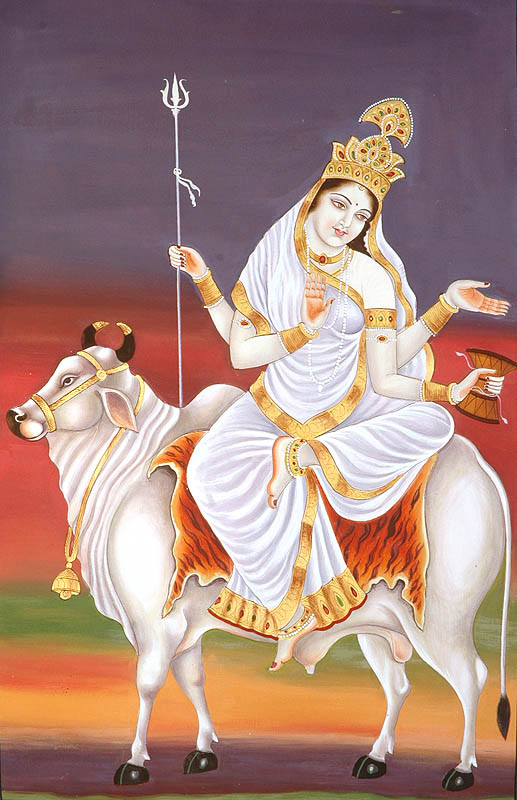
Nine forms of Durga worshipped during Navaratri - 08 Maha Gauri

She is worshipped on the eighth day of Navaratri. Her power is unfailing and instantly fruitful. As a result of her worship, all sins of past, present and future get washed away and devotees get purified in all aspects of life. Maha Gauri is intelligent, peaceful and calm. Due to her long austerities in the deep forests of the Himalayas, she developed a dark complexion. When Lord Shiva cleaned her with the water of the Ganges, her body regained its beauty and she came to be known as Maha Gauri, which mean extremely white.

She wears white clothes, has four arms, and rides on a bull. Her right hand is in the pose of allaying fear and her right lower hand holds a trident. The left upper hand holds a ‘damaru’ (a small two headed drum) and the lower one is in the pose of granting boons to her devotees.

According to Hindu mythologies, the Goddess Shailputri at the age of sixteen was extremely beautiful and was blessed with fair complexion. Due to her extreme fair complexion she was known as Goddess Mahagauri. Due to her fair complexion Goddess Mahagauri is compared with the conch, the moon and the white flower of Kunda . She adorns white clothes only and due to that She is also known as Shwetambardhara.


Monday, October 19, 2015

Nine forms of Durga worshipped during Navaratri - 07 Kaal Ratri

This is the seventh form of Mother Durga and is worshipped on the seventh day of Navaratri. She has a dark complexion, disheveled hair and a fearlessness posture. A necklace flashing lightning adorns her neck. She has three eyes that shine bright and terrible flames emanate from her breath. Her vehicle is the donkey. Her raised right hand always seems to grant boons to all worshippers and all her right lower hand is in the pose of allaying fears.

What I have been trying to find out is why a donkey. What I could infer is, the donkey is a very stubborn animal. If it has made up its mind to do something, it will - irrespective of the consequences. Also the donkey may appear docile, but with its hooves, it can give away a strong kick. Are these the reasons for the vahana for Kalratri? No idea.

Her left upper hand holds a thorn-like weapon, made of iron and there is a dragger in the lower left hand. She is black like Goddess Kali and holds a sparkling sword in her right hand battle all evil. Her gesture of protection assures us of freedom from fear and troubles. So she is also known as ‘Shubhamkari’ – one who does good.

She is clad in loose red cloth to cover her upper body and wears tiger skin below her waist. Her whole body adorns various forms of thorny garlands, anklets, waist-bands, wrist-bands and armlets

Though the appearance of Maa Kalratri is dreadful, her grace is generous toward devotees. Worshiping Kalaratri on the seventh day gives abundant fruitful result. With her grace, devotees get power, position and eminent status on earth. She protects her devotees against evil influence of demons and wrong people. Worshiping her, devotees get complete protection and long life.

 No one could kill Raktabeej, as even one drop of his scattered blood was able to form another embodiment of Raktabeej. And that way, scattered blood of Raktabeej formed countless other  Raktabeej. Devi Durgai manifested herself in Kalaratri, and kept a Patra (vessel) to keep and imbibe entire blood of his body. Her extreme violent appearance while destroying Raktabeej and other demons hugely terrified all organisms of Universe. But still, she is a generous Goddess for her great devotees.

Another legend says that, once there was a demon named Durgasur who tried to attack Kailash, the abode of Parvati in the absence of Shiva. Parvati got to know about this and created Kaalratri and said her to go and warn Durgasur, when Kaalratri reached there Durgasur's guards tried to capture her but she grew big in her original form and said Durgasur that his death was nearby. After that when Durgasur came to invade Kailash, Parvati battled him and killed him gaining the name Durga. Here Kaalratri serves as an agent who gives the message and warning from Parvati to Durgasur.

During Navratri, Saptami Poojan of Devi Kalratri is considered as Maha Pooja or great worship of Goddess Durga. Delighting this deity, devotees certainly get enormous happiness, power and comforts in life. Maa Kalratri is Worshiped to destroy agony of awry influence from life of mankind. On the seventh day of Navratri Pooja, Saptami fast is observed to please this deity. Tantra-mantra practices are also performed and accomplished under blessings of this Goddess. Seventh day of Navratri pooja is envisaged as one of the great days in Durga Pooja. Worship Maa Kalaratri on the seventh day of Navratri Pooja and obtain her enormous grace.


Sunday, October 18, 2015

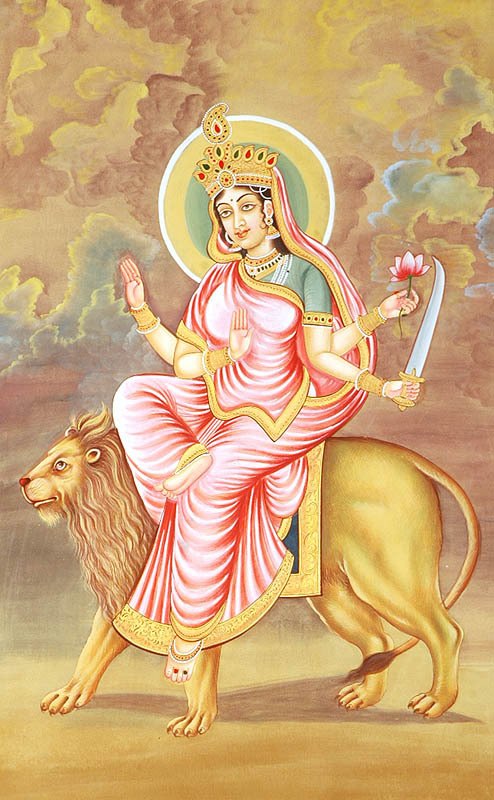
Nine forms of Durga worshipped during Navaratri - 06 Katyayani

The sixth form of Mother Durga is known as ‘Katyayani’, who is worshipped on the six day of Navaratri. The legend behind her name goes thus: Once upon a time, there was a great sage called Kata, in whose lineage was born the sage Katyayan. Katayan was very famous and renowned in the lineage of saints. He underwent long austerities and penance in order to receive the grace of the Mother Goddess. He wished to have a daughter in the form of a goddess.

According to his wish and desire the Mother Goddess granted his request. His daughter was the Mother Durga reborn. As she was born in Katyayan's house, she was called Katyayani.
Goddess Katyayani rides on the magnificent lion and depicted with four hands. Goddess Katyayani carries lotus flower and sword in her left hands and keeps her right hands in Abhaya and Varada Mudras.

It is said that in this form Mahishasura was killed. This was form that created by the devas, who was eventually born in Katyayan's house and who came and killed Mahishasura.

Mother Katyayani a blesses you with better health and wealth. By worshipping  Katyayani, you may develop great strength to fight all disease, sorrows and fears. In order to destruct the sins accumulated over your several lives, you should religiously worship Katyayani.

This is the daughter form of Durga. Here is she a loving daughter. She is epitome of love but won’t hesitate to rise up in anger to defend righteousness and Dharma. It is believed that Maa Katyayani persistently battles against the evil and deceitful entities.

She is also referred to as the Goddess of Vrindavan. She was widely worshiped there by the Gopis.


Saturday, October 17, 2015

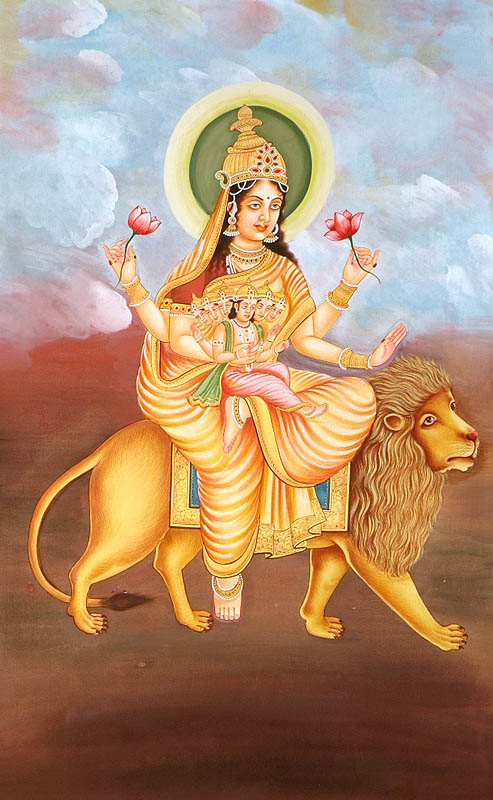
Nine forms of Durga worshipped during Navaratri - 05 Skandamata

Skandamata is the fifth form of Goddess Durga.  Skanda is another for Kartikeya and Mata is the name of mother. Her worship takes place on the fifth day of Navaratri. She is accompanied by the Lord Skanda in his infant form. Skanda Mata has four arms and three eyes, holds the infant Skanda in her right upper arm and a lotus in her right hand which is slightly raised upwards. The left arm is in pose to grant boons with grace and in left lower hand which is raised also holds a lotus. She has a bright complexion and often depicted as seated on a lotus, because of that Skandamata is also known as Goddess Padmasana. Devotees who worship this form of Goddess Parvati get the benefit of worshipping Lord Kartikeya.


Friday, October 16, 2015

Nine forms of Durga worshipped during Navaratri - 04 Kushmanda

Kushmanda is the fourth form of the mother goddess and is worshipped on the fourth day of Navaratri. The meaning of the name ‘Ku-shm-anda’ is as follows: ‘Ku’ = a little; ‘ushma’ = ‘warmth’; ‘anda’ = ‘the cosmic egg’. So she is considered the creator of the universe. The universe was no more than a void full of darkness, until her light spreads in all directions like rays from the sun. Often she is depicted as having eight or ten hands.
She holds weapons, glitter, rosary, etc., in her hands, and she rides a tiger or a lion.

The glow and radiance of her body is as luminous as that of the Sun. It is believed that Goddess Kushmanda provides direction and energy to the Sun. Hence God Sun is governed by Goddess Kushmanda.

As per the Hindu mythology, Lord Vishnu was able to start creating the universe when Maa Kushmanda smiled like a flower which blossomed with a bud. She created the world from nothing, at the time when there was eternal darkness al around. This Swarup of Maa Durga is the source of all. Since she created the universe, she is called Adiswarup and Adishakti.

The Goddess also loves the sacrifice of a pumpkin. Hence, sacrificing pumpkin in front of the Goddess is a crucial ritual of the fourth day.

 It is advised that one should perform worship for this almighty only after absolute purification of heart and soul. Impure heart can make this Goddess infuriate. Grace of this Goddess finishes all types of physical and mental disorders and ailments. By spiritually worshiping Goddess Kushmanda, the worshiper can become free from afflictions. Her grace endows divine spark to adorers. Worshiping her in simple process, the worshiper can feel the existence of this great almighty. Goddess Kushmanda is true symbolism of divine spark. Worshipers of this Goddess certainly obtain cosmic energy that enhances their positive aura. Positive reflection makes the person glorified in society. With blessings of Devi Kushmanda, devotees can achieve name, fame and other comforts of life.


Thursday, October 15, 2015

Nine forms of Durga worshipped during Navaratri - 03 Chandraghanta

The third facet of Goddess Durga is ‘Chandraghanta’, who is worshipped on the third day of Navaratri, for peace, tranquility and prosperity in life. She has a ‘chandra’ or half moon in her forehead in the shape of a ‘ghanta’ or bell. That is why she is called ‘Chandraghanta’. She is charming, has a golden bright complexion and rides a tiger. She has ten hands, three eyes and holds weapons in her hands. She is the apostle of bravery and possesses great strength to fight in the battle against demons. One of her hands is in abhaya mudra where she is showering blessings on her devotees.

Goddess Chandraghanta is the married form of Goddess Parvati. After getting married to Lord Shiva , the Goddess started adorning on her forehead, the half moon and due to which Goddess Parvati was known as Goddess Chandraghanta. It is also said when Shiva had come to marry her with his followers who primarily ugly, horrible looking, the Goddess requested Shiva to appear as a charming prince. On seeing this beautiful form the Goddess, Shiva agreed.

This form of Durga is not completely different from earlier forms. It shows that when provoked she can be malevolent. Her malevolent form is said to be Chandi or Chamunda Devi. She is otherwise the very embodiment of serenity.

You need to follow simple rituals to worship Goddess Chandraghanta. You should first worship all the Gods, Goddesses and Planets (General prayers) and then offer prayer to Lord Ganesha and Kartikeya and Goddess Saraswati, Lakshmi, Vijaya, Jaya – the family members of Goddess Durga. The pooja should be concluded by worshipping Goddess Chandraghanta followed by a heartfelt prayer to Lord Shiva and Lord Brahma.


Wednesday, October 14, 2015

Nine forms of Durga worshipped during Navaratri - 02 Bhramacharini

She is worshipped on the second day of Navaratri and is the second form of Mother Goddess. Bharmacharini means one who practices devout austerity. She enlightens us in the magnificent embodiment of Durga with great powers and divine grace. She holds a rosary in her right hand and a Kamandal in her left hand. She is blissful and endows happiness, peace, prosperity and grace upon all devotees who worship her. She walks bare feet.
Filled with bliss and happiness, she is the way to emancipation - Moksha.

Goddess Parvati took birth at the home of Daksha Prajapati and was called Sati. It is said to win Shiva as her husband, this is the form in which Sati did her penance for Shiva. What I am not sure is, if it Sati that is being referred to, or is it Parvati's penance to win Shiva.


Tuesday, October 13, 2015

Nine forms of Durga worshipped during Navaratri - 01 Shailaputri

Shailaputri literally means the daughter (putri) of the mountains (shaila). Variously known as Sati Bhavani, Parvati or Hemavati, the daughter of Hemavana - the king of the Himalayas, she is the first among Navadurgas. Her worship takes place on the first day of Navaratri – the nine divine nights. The embodiment of the power of Brahma, Vishnu and Shiva, she rides a bull and carries a trident and a lotus in her two hands.

After the self-immolation in the form of Goddess Sati, Goddess Parvati took birth as the daughter of Lord Himalaya. In Sanskrit Shail means the mountain and due to which Goddess was known as Shailputri, the daughter of the mountain.
It is believed that the Moon, the provider of all fortunes, is governed by Goddess Shailputri and any bad effect of the Moon can be overcome by worshipping this form of Adi Shakti.
It is said that in this form, Parvati got married to Lord Shiva.