Pages

Showing posts with label Diwali. Show all posts

Thursday, November 26, 2015

Last evening - 25 November

When I got home yesterday evening, I saw houses with the led lights on their balconies.
First I thought these Diwali lights, then I saw some houses which did not have lights during Diwali now had lights.
Ok, the lights must be for Guru Nanak - i thought.

I have a Sikh family staying near my house, so I wanted to see if they had lights on. No, their house was like any other day.

Then I figured out, yesterday was Tripuri Purnima.

It said that gods goes to sleep for four months,this is the day when they wake. This is why the Autumn Durga Puja is a akal (untimely) puja.

This is also the day when the Gods celebrate Diwali, as this day Shiva had destroyed Tripura with one single arrow. That is another story.

Some say this is the day Kartikeya killed Tarakasura.

In the south here, people will visit Shiva temples, light up their houses and read the Skanda Purana, which the people here called Kathika Puranam.

Friday, November 13, 2015

Bhaier Kopale Dilam Phota, Jomer Duare porlo Kaata - Bhai Dooj/ Bhai Phonta - Day Five of Diwali

Two days after Diwali, is what in North India is called Bhai Dooj and in Bengal, is called Bhai Phonta. This year, the date is Friday 13th November 2015. The bengali verse (in the title) is what the sisters recite when they put a dot on their brother's forehead.
Some also refer to this as Bhatri Dwitiya and some call it Yama Dwitiya.
Dwitiya, as this the second day after the new moon, and Bhai / Bhatri for brother.


Two days after Kali Puja is used as Bhai Phota Day  in West Bengal .
Bhai Phota happens in Shukla Paksha and in Kartik month every Bengali year.

Bhai means Brother, and Phota means Dot so putting the dot on the brother's forehead is the day of Bhai Phota. Also as this happens on the second day after Amavasya (Dooj), this is also called Bhai Dooj.

The detailed verse is here :

“ Bhaier kapale dilam phonta,
Jamer Duare porlo kanta,
Jamuna Dae Jomke phonta,
Ami di amar bhaike phonta,
Bhai jeno hoy lohar vata.”


which means –
“on my brother's forehead I put the mark,
Death's door are now closely crossed
Yamuna applies the mark on Yama
While I give the mark to my brother
Let my brother be as tough as Iron”

The ritual is simple. The sister makes the brother sit cross legged on a mat, on the floor. She then lights a lamp. A paste made specially for this day, is put on their brother's forehead. The paste normally created using Sandal paste, Kumkum,;Vermilion and Curd.  Sisters pray for long  and healthy life for their brothers by giving them blessings using a special verse (mentioned above). Sisters arrange various types of sweets and snacks for their siblings after applying the Tilak and then break their fasting of Bhai Phota. If the sister is elder, the brother takes this as a blessing, and if this is a younger sister, then as a token of love.

The sister traditionally recites the verse three times and then washes his hand and serves an exclusive lunch where fish, meat and other vegetables dishes waits for the brother.

Legends say, Yamuna is said to have performed this for the first time for her brother, Yama, on this day.


Yama, the god of Death had not visited his sister Yamuna for 12 years. Yamuna, the goddess of Yamuna river, was sad and consulted Ganga, the goddess of Ganga river. Ganga reminded Yama of his sister, upon which Yama visits her. Yamuna was overjoyed to see her brother, and prepared a bounty of food for Yama. The god Yama was delighted, and asked Yamuna what she wanted for gift. She wished that he, her brother should return and see her again soon. Yama was moved by his sister's love, agreed and to be able to see her again, made river Yamuna immortal.


This ends the five day celebration of Diwali.

Thursday, November 12, 2015

Bali Pratipada and Gujarati New Year Day - Day Four of Diwali

Bali Pratipada is performed on the day after Diwali. Bali Puja coincides with Govardhan Puja. While Govardhan Puja is dedicated to Govardhan hills and Lord Krishna, Bali Puja is performed to seek blessings of asura Bali.

Due to boon bestowed by Vishnu in his Vamana avatar, Bali is worshipped in India during Diwali. Bali was pushed to Patala by Vamana, but due to generosity of the king Bali, Vishnu allowed him three days to visit Bhulok (i.e. the earth). It is believed that  Bali resides on the earth for three days and blesses his devotees during these days.

In Kerala, king Bali is worshipped during Onam and the concept of Onam is same as that of Bali Puja in other parts of India.

For the brahmin families in Karnataka, today is the day when they will worship Bali, Lakshmi and Vishnu.

Today also happens to be the new year day for the Gujarati community.

Govardhan Puja - Day Four of Diwali


Govardhan Puja, also called Annakut (meaning a heap of grain), is celebrated as the day Krishna defeated Indra by lifting the Govardhan hill.This is the fourth day of Deepawali (Diwali), the Hindu festival of lights.

On this day the inhabitants of Vrindavan  would hold a harvest festival in honor of  Indra, who provided the rains essential for the harvest.
Krishna convinced the inhabitants of Vrindavan to honor Govardhan Hill instead, whose fertile soil provided the grass upon which the cows and bulls grazed, and to honor the cows and bulls who provided milk and tilled the lands. Outraged, Indra retaliated with terrifying thunderstorms. Krishna, calmly lifted Govardhan Hill with the little finger of his left hand. For seven days and seven nights Krishna held up Govardhan Hill, providing a giant umbrella to shelter the inhabitants of Vrindavan from the torrential rain. Realizing the futility of his actions, Indra bowed down before Krishna and offered prayers of supplication.

To celebrate this festival, devotees build a replica of Govardhan Hill made of various opulent foods, worship Lord Krishna as the lifter of Govardhan Hill, worship the hill as His incarnation, and worship the cows and bulls who are dear to the Lord.

At the end of the festival, the hill ofbhog is distributed to the public.

On this auspicious day the people prepare fifty-six (chhappan bog) or one hundred and eight different varieties of delicious dishes to offer Krishna as 'Bhog'. In the temples, specifically in Mathura , the deities are given milk bath, dressed in new shining attires and decorated with ornaments of dazzling diamonds, pearls, rubies and other precious stones and metals. Then they are worshiped, offered prayers and bhajans and also offered delicious sweets, fruits and eatables that are ceremoniously raised in the form of a mountain before the idols. This is also the day when the King Bali is supposed to come and greet his subjects. While Kerala celebrates this as Onam on a different date, in other parts of the country, this day is also known as 'Bali Padyami'.

There is a custom in which on this holy day the wife applies the 'Tilak' on the forehead of her husband, garlands him, performs his 'Aarti' and also prays for his long life. Then the husband gives her a gift in appreciation of all the tender care that his wife showers on him. This is called Gudi Padwa in Maharashtra and is festival of celebrations and respect of love and devotion between the wife and the husband. People invite their newly married daughters with their husbands on this day of Gudi Padwa for special meals and give them gifts.

Some people consider this day as the appearance day of the earth in the form of a cow. So, it is celebrated as birthday or as a special day of cows.  As a mark of respect, we worship cow and offer them fresh grass and food on this day.

Wednesday, November 11, 2015

Bangalore Diwali

It has been raining non stop since Sunday night.
Temperatures have dropped making it nice.

Today traffic wasn't much so manageable.

But the roads!! All dug up, hardly walk able or drive able. If you are walking, chances you will get splashed, are very high. And if you are driving, you cannot see the potholes so not sure where you may end up.

So much for Diwali !!


Firecrackers and Diwali

Who burst the first firecracker? Historically gunpowder did not exist till the Chinese invented it, so probably before the 13th century there was a different mode of fireworks. Burning of different resins caused a lot of smoke and some light. Pieces of bamboo when lit and thrown skywards could burn and also create a popping sound due to the hidden air pockets inside.

There may be a scientific reason behind the fireworks. They cause smoke which kills most of the insects which come up and breed at this time of the year, especially mosquitoes.

~~~~~~~~~~

Leave the reasoning behind.

Have fun. Have a Happy and Safe Diwali.


Music of Kali

Kali is dark. So she is called Shyama.

An entire genre of Bengali devotional songs dedicated to Kali and is called Shyama Sangeet.

So many poets have to please the Goddess with their music.

Shyama Sangeet has a history, older than Kali Puja in Bengal. Kali has been revered for long in Bengal. There are some instances of devotional music written in praise of Kali, which were written sometime in the 12th or 13th century.In the 16th century there is one example of Chandi Mangal Kabya (also called Kavikangal Chandi) by Mukundaram Chakraborty. Written in Panchali style, it is an ode to the holy Mother.

Ramprasad Sen, the poet tried to free the devotion to Kali from the Tantra form and tried giving it a simpler touch. That resulted in the loving form of Kali come across.  He wanted to rid the society of the cult  in the name of worshipping Kali and to establish in its place a musical representation of the relationship of eternal and sublime love and care between the mother and her child.

Recognized as one of the greatest poets in India, he shared the spirit of devotional surrender, expressing a yearning so powerful, and at times so heart-wrenching, that listeners were inspired to renounce all selfish concerns and worldly attachments.

Many of Ramprasad's songs have been lost. Some famous notes by him are: Man Re Krishi Kaaj Jaano Na (O mind, do you not know cultivation?), Dub Dere Mon Kali Bole (dive deep, o mind, in the name of Kali), Ebaar Kali Tomaye Khabo (Now I will eat you Kali) . These songs have been always popular in Bengal.


In the late 18th century Bengal came Kamalakanta Bhattacharya who wrote many songs in priase of Kali.


In early 19th century Bengali came Dasharathi Ray who began singing in the kabiyal style but did not like the debates that took place. He then took to writing in the panchali style and became famous.  One very popular song of his is Dosh Karo Noye Go Maa, sung by Panna Lal Bhattacharya


Trailokyanath Sanyal, Dvijendralal Ray, Nabai Moyra, Bireshvar Chakravarti, and Kalidas Bhattacharya are among a large number of mid-nineteenth century literary types (not necessarily practicing devotees) who adopted the Kali-song genre as one poetic form among the many that they experimented with. While some refined the style to conform to elite urban tastes, others among them appropriated the image of the mother goddess as a nationalist symbol of India. Poetry sung to different kinds of highly developed musical forms was a chief source of entertainment for urban Bengalis in the nineteenth century, and Kali songs entered the general repertoire.

(Aamaye De Ma Pagol Kore - Trailokyanath Sanyal)


Nabai Moyra, who was Vaishnav wrote beautiful poems between the similarities of Shyam (Krishna) and Kali. He is telling the mother goddess to discard the sword and take up a flute, dance like Krishna.


Nazrul composed some songs which are part of Shyama Sangeet. Unlike other poets referring to Kali as the mother, Nazrul referred to Kali as the daughter.


Tagore has also composed songs in praise of Kali. In Balmiki Pratibha, Valmiki sings songs in praise of Kali.


There have been many poets who have written songs in praise of Kali but I want to mention Pannalal Bhattacharya. Brother of Dhananjay Bhattacharya, the singer, Pannalal made Shyama Sangeet famous in the 20th century.
Pannalal developed a special style of singing with devotion. His distinct singing voice and his devotional spirit have melted the hearts of countless devotees of Kali across Bengal. He became a great devotee of Kali and always remained engrossed in her thoughts. At the young age of 36, he committed suicide as he did not get the vision of Kali.


Birth of Kali and killing of Raktabija - Kali Puja Second / Third Day of Diwali

Kali Puja is celebrated in eastern India on Diwali. While in many parts of India, Lakshmi is worshiped, Kali's worship on the day of Diwali is of great importance.

It is said, as per Devi Mahatmayam, this is the day, when Kali appeared and killed Raktabija.

In the fight that was ensuing between Durga and the demons, there appeared a demon, called Raktabija.

Kali is called Bhadrakali in the south of India, and is said to have emerged from the third eye of Shiva and had killed the demon, Darika.

Kali shows the need for discrimination and dispassion and that good and evil arise from the same source and to spiritually progress we must overcome the terrible and violent side of life.

~~~~~~~~~~~


Here is the story of Kali's birth, from Devi Mahatmayam. This story appears in the seventh chapter and continues to the next chapter where Raktabija is killed.

Shumbha commanded Chanda and Munda, his worriers to go and capture the goddess. The demons went to the battle field, where the Goddess Ambika was resting, on her lion. Instead of talking to her, the asuras attacked from all sides. Angry, the goddess frowned.

From her frowning forehead emerged a female figure. This figure had a sword in one hand, and a noose in the other. Clad in a dress made of the skin of the leopard, she was clad in jewels made from bones. Her was skinny herself and looked like a skeleton. She looked scary - her face was larger in proportion to her body and her tongue was jutting out of her mouth, Her eyes were sunken and she was making a noise that was creating disturbance in the atmosphere.

Increasing her size, this being started catching and gulping down the asuras. This was Kali.

Kali then rushed towards Chanda and Munda. The asuras seeing the goddess, attacked her. Kali started laughing, her teeth shining like thunder bolts. Catching Chanda, and utter "Hum" she cut his head off, with her sword. She then killed Munda similarly.

Ambika, pleased with her feat gave the goddess the name of Chamunda and Chandika. This killing of Chanda and Munda is celebrated during Sandhi Puja of Durga Puja, in Bengal.

 Hearing this, Shumbha, the king of demons asked his army to kill the Goddess who was destroying his able warriors.

Hearing him, the army attacked the Goddess. Seeing the army attack, the Goddess strung her bow sting. The noise was deafening. Her lion started roaring. The goddess then started ringing the bell she was holding in one of her hands.

Kali then attacked the army. With only Ambika and Kali fighting the other gods, let their female forms join the fight. From Brahma emerged Brahmani, sitting on a swan. Shiva's female form came next, sitting on a bull. This was Maheswari. Kartikeya's female form, Kartikeyi came next sitting on a peacock. Then came Vishnu's form, in the form a female boar, called Varahi. A form called Narasinghi came looking like a half lion, half woman, Then came Vaishnavi, female form of Vishnu. Then came Indra's form called Aindri, sitting on an elephant.

All these goddess then started fighting and attacked the army. Meanwhile Ambika asked Shiva to go as her messenger and ask Shumbha and Nishumba to surrender. In this form, the Goddess is also called Shivadooti, as she had asked Shiva to go as her 'doot' (messenger).

As guessed, Shumbha and Nishumbha refused and the war took a fierce form. Seeing the goddess attacking, Raktabija came to the battlefield. Raktabija had a boon that whenever a drop of his blood fell on the ground, a duplicate Raktabija would be born at that spot (rakta=blood, bija=seed; "he for whom each drop of blood is a seed").

Raktabija attacked Aindri. The goddess hurled her bolt at the asura. Wounded, Raktabija began bleeding. Each drop of blood then started giving rise to a clone. As more weapons were hurled at the demon, each drop of blood gave rise to a replica. Soon the battlefield was full of many Raktqabijas fighting. Seeing this Kali went on the field and started gulping down the Raktabija replicas. When only one was left, Ambika attacked the asura with her trident, and Kali swallowed all the flowing blood. Raktabija was dead.

Kali became mad with blood lust after this incident. She started dancing the dance of destruction and forgot that She had already killed Raktabija. She kept on slaying the innocent after that. Seeing this, the Gods became extremely worried and approached Lord Shiva for help. Only Shiva had the power to stop Kali at this stage. So, Lord Shiva went and lay down among the corpses where the Goddess was dancing. Accidentally, Kali stepped on Shiva and soon She realized Her mistake. It is then Her tongue immediately came out of embarrassment and She calmed down. She was ashamed that Her blood lust had prevented Her from recognizing Her own husband. Thus, She came back to Her original form and the destruction was stopped. Shiva lying at Kali's feet also symbolizes the supremacy of Nature over man. It clearly shows that without Kali or Shakti even a powerful force like Lord Shiva is inert. Hence, Kali is shown as stepping on Shiva's chest.


~~~~~~~~~~

Kali teaches that pain, sorrow, decay, death, and destruction are not overcome by denying or explaining them away. These are inevitable parts of life and denying them is futile. For us to realize the fullness of our being and to realize our potential, we must accept these parts of existence. Kali's gift is freedom. The freedom of the child to revel in the moment, obtained only after confrontation with or acceptance of death. Kali is Mother, not because She protects us from the way things are, but because She reveals our mortality to us and releases us to act fully and freely; She releases us from the web of pretense, practicality and rationality.

Of all the Devi forms, Kali is the most compassionate because She provides liberation to Her devotees. A soul who engages in spiritual practice to remove the illusion of the ego sees Mother Kali as sweet, affectionate, and overflowing with love for Her children, as was seen in the case of Shri Ramakrishna.


Tuesday, November 10, 2015

Bhoot Chaturdashi

Bhoot Chaturdashi is observed on the second day of Diwali. The  unsatisfied spirits, bhoot, are worshipped.

In some regions people offer food – cooked rice and til to the spirits.

The rituals coincide with the popular Yama Chaturdasi and Naraka Chaturdasi rituals.

This particular ritual is of importance in eastern parts of India.

This slowly gives way to Kali Puja which starts on this day, and ends the next day.

~~~~~~~~~~~~~~~~

Some celebrate this day as the day of Roop Chaturdashi, and people take bath after applying oil.

A day before Diwali used to be day when all fire crackers were bought.  Last year's leftover crackers were brought out and dried in the afternoon sun.

Evening was a visit to the Kali Bari. Then back home and light 14 lamps to ward off evil spirits.

This was also the day for Choddo Shak (14 different greens).

~~~~~~~~~~~~~~~~

Just one note. There is a puja - Kali Chaudas, which is performed usually in Gujarat. This is different than the Kali Puja in Bengal.


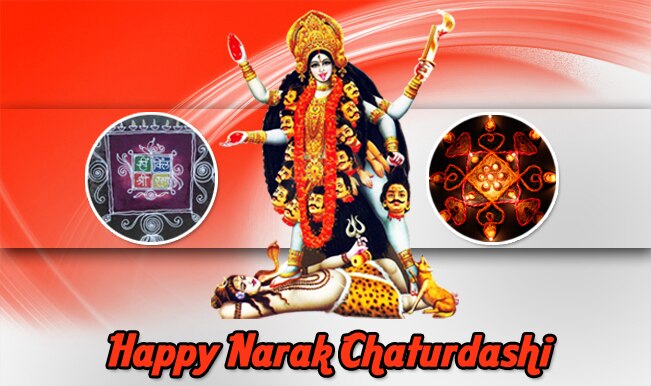
Narak Chaturdashi - Day Two of Deepawali

While in Bengal, this is the day Kali Puja starts. This year, Amavasya Tithi Begins at 21:23 on 10 th November 2015 and ends at 23:16 on 11 th November 2015.


For Kali Puja, the day when Amavasya starts is considered while for Lakshmi Puja/ Deepawali the day when Amavasya ends is considered. For this, on many days Kali Puja happens a day before the designated day for Deepawali.

This day is also called Bhut Chaturdashi or Kali Chaturdashi. This is the day to abolish and kill off the laziness in our lives.

Some say this is the day when Hanuman gulped down the sun.

There also a legend associated with Bali, grandson of Prahalada. King Bali became the most powerful king on earth. But he became highly arrogant. His form of charity was an occasion for pomp and show and those who went to seek Alms from the king Bali suffered insults and humiliation. His arrogance and misrule ended when the Lord appeared as beggar (vaman avtaar). King Bali asked the dwarf beggar to get anything in his kingdom. Lord replied he just want a piece of land that could be covered in his 3 steps. And with his first step Lord Vishnu covered the entire heaven, with the second step the earth and asked Bali where to keep his third step. Bali offered his head and became spiritually enlightened. The Narak chaturdashi day therefore is dedicated to lights and prayers and the elimination of greed.

Here in South India, this is supposed to be the day when Narakasura was killed.

Celebrated as the second of the auspicious Deepavali days, Narkachaturdashi originates from days of Lord Krishna. God Yama is also worshiped on this day to get over the fear of demon Narakasura. Lamps with four wicks are lighted at various places. People make an effigy of Narakasura, carry it to the outskirts, and burn it. Later, they take bath and burst crackers. This is the day of Narakasura's death and hence a celebration for all.


~~~~~~~~~~~~~~~~~~~~~~

From the Bhagwad Puran - Krishna kills Narakasura

It is said that Narakasura was the son of the earth, by Vishnu, in his incarnation as a boar. He became a demon due to the bad association of Bana, another demon. It is mentioned in the Bhagwad Purana, Birth alone is not always the criterion of goodness; unless and until one is trained in the culture of good association, one cannot become good. Thus Narakasura became a demon even though he was born good. Narakasura was also called Bhaumasura, as he was born from Bhoomi (earth).

He was a powerful demon. He stole Varuna's umbrella, Abhoga. Abhoga, fashioned from a cobra's hood such that no water could penetrate it. He also stole the divine earrings from Aditi, the mother of Devas. He would forcibly kipnap damsels and hold them captive.

Hearing this complaint by Indra, Krishna, accompanied by His wife Satyabhama, immediately started for the abode of Narakasura. Both of them rode on the back of Garuda, who flew them to Pragjyotisa-pura, the capital city of the demon. It was not a very easy task to enter the city , as it was very well fortified. First of all, there were four formidable forts guarding the four directions of the city, and it was well-protected on all sides by great military strength. The next boundary was a water canal all around the city. The next fortification was of anila, a gaseous substance. After this, there was a network of barbed wiring constructed by a demon named Mura.

When Krishna arrived, he broke all the forts to pieces by the strokes of 'gada' (club, called Kaumodaki) and the constant onslaught of the arrows . With his Sudarshana Chakra, he destroyed the channels of water and the gaseous boundary. By the vibration of His conchshell, He not only broke the hearts of the great fighters, but also the fighting machines which were there. Similarly, the walls around the city were broken.

The demon Mura heard the vibration of the conchshell, awakened from his sleep, and  came out to see what was happening. He had five heads and had long been living within the water. The Mura demon was as brilliant as the sun at the time of the dissolution of the cosmic manifestation, and his temper was like blazing fire. His body was so dazzling that it was difficult to see him with open eyes. When he came out, he first took out his trident and began to attack Krishna.  First of all he attacked  Garuda, by whirling his trident and he began to vibrate sounds through his five faces like the roaring of a lion. The roaring produced by the vibration of his mouths spread all. Krishna saw that the trident of the Mura demon was gradually rushing toward  Garuda. Immediately, by a trick of His hand, He took two arrows and threw them toward the trident, cutting it to pieces. Simultaneously, he pierced the mouths of the demon Mura with arrows stopping the noise and shot down the trident.
Mura demon immediately began to strike Krishna with his club. But Krishna, broke the club of Mura to pieces . Mura then began to attack Krsna with his strong arms, but by the aid of his discus. Krishna killed Mura. From then on, Krishna became known as Murare.

Seeing this. Narakasura came out and immediately released a weapon called Sataghni, by which he could kill hundreds of warriors with one stroke, and simultaneously all his soldiers also threw their respective weapons at Krishna. Krishna countered all the weapons, and all soldiers fell dead.

Taking a trident in his hand , the demon hurled it towards Krishna which was cut off by Sudarshan Chakra. Krishna then killed Narakasura by cutting off his head.


Monday, November 09, 2015

Dhanatrayodashi - Dhan Teras Day One of Deepawali


As is commonly seen, a word in Sanskrit may have many meanings. So while DHAN commonly means WEALTH, there are other root words for DHAN.

So Dhanteras has different meanings depending on the way of looking at.

DHAN - Wealth
TRAYODASHI - Thirteen (Trayodashi is now called Teras in Hindi, so DHAN TRAYODASHI became DHAN TERAS).

DHANUS may mean a bow but it also has links with surgery and DHANYAN means desert.

So the word DHANTRYODASHI has many meanings. The thirteenth day , day of wealth.
This is also called as the birthday of DHANVANTARI - God of Medicine. The one who has seen the end (anta) of DHANUS (Surgery) is DHANVANTARI.
The word dhanvan means a desert -  dhanvachara meaning, he who moves in a desert). DHANVANTARI  is like the oasis in the desert of worldly existence.

Many meanings and many legends.

~~~~~~~~~~~~~~~~~~~~~~~~~~~~~~~~~~~~~~~~~~~~~~~~~~~~~~~~~~~

Once there was a young prince and his death was predicted by a snake-bite on the fourth day of his marriage, which happened to be two days before the new moon, on the thirteenth day, or a trayodashi.. On that particular day, his newly-wed wife did not allow him to sleep. She laid out all her ornaments and lots of gold and silver coins in a heap near the entrance of their sleeping chamber and lit lamps all over the place. Then she narrated stories and sang songs to keep her husband from falling asleep.

At the stroke of midnight, Yama, the God of Death, reached the palace in the guise of a snake to kill the prince. But Yamraj’s eyes were blinded by the dazzle of the Diyas. This prevented him from entering the room of the prince

When the attempts to enter the room failed, Yama hid near the ornaments and coins, thinking that the prince might come there to look at the valuables.

But the clever young bride did not allow the prince to venture out. Instead she said interesting stories and songs. The prince was glued to the stories and did not move from the place. Yama also forgot about his mission listening to the songs and stories. Soon the sun appeared and Yama returned disappointed.

This incident is celebrated as Yamdeepdaan. The tradition of burning lamps through the night on the day is dedicated to Yama.

~~~~~~~~~~~~~~~~~~~~~~~~~~~~~~~~~~~~~~~~~~~~~~~~~

Dhantrayodashi is also considered the birthday of Dhanvantari. This is the day when is supposed to have arisen , when the cosmic ocean was churned for nectar. Considered an incarnation of Vishnu, he is depicted,  clad in bright yellow silk, He is depicted with four hands- the upper pair of hands carrying sankha and chakra, and the lower pair, a leech and pitcher. Interestingly, the leech was part of the doctor’s kit in olden days since it was used to suck out impure blood from the patient‘s body. Even now, extract from its saliva is used to prevent clotting.


People start preparing for this day few weeks in advance. Houses and shops get cleaned and decorated. The special colorful patterns are laid out near the entrance of the house. In some regions, lamps lit are dedicated to dead ancestors and floated down a river or pond.

On this day, Hindus purchase gold, silver and other utensils. Many people begin the purchase for Diwali celebrations on this day. Crackers, candles, lamps and other items needed for Diwali are purchased on this day.

~~~~~~~~~~~~~~

Some also celebrate this day as the birthday of Lord Kubera, who is the God of Wealth.

~~~~~~~~~~~~~~~~~

Dhan is wealth. Life is wealth.

So lets cherish the life we have, the wealth of life.

Happy Dhanteras.

Sunday, November 08, 2015

Diwali or Deepawali

In practice, the Diwali celebration starts on DhanTeras (13th day from full moon) until the second day of Karthik New Moon.
In South, NaraChatrudashi is the real Diwali. This is also the day when Kali Puja is done in Bengal.
Diwali is big festival for the Business Class who end their Fiscal year a day before Diwali and worship Lakshmi for a start of a promising year.

Some people say Diwali is the day Rama returned to Ayodhya after his exile. Some people believe this to be the day Rama was crowned king.
As the dwarf, Vamana, Vishnu is supposed to have conquered the asura king Bali, on this day.
Some say this is the day Lakshmi emerged from the cosmic ocean and chose Vishnu as her husband.
Like on Mahalaya, this is also the time to pay respect to the departed souls.Some say the lights and firecrackers are a way to show the departed, a path to heaven.

Gambling has entered to Diwali. Folk tales talk about the game of dice was created on this day by Shiva. Skanda Purana talks about the twelve boards on the dice board :

The universe is the board. The months are the squares.The playing pieces are the lunar days (dark and bright both) and the sun's path northwards is one dice and the path southwards is another dice.


Five Days - Five Festivities. Five Rituals. Five Legends.

Tomorrow (09th November 2015) starts the first day - Dhanteras.


Saturday, November 07, 2015

5 days of Diwali

Day 1 :Dhanteras
Dhanteras marks the first day of the five-day-long Diwali Festival. Dhanteras Festival, also known as Dhantrayodashi or Dhanwantari Triodasi, falls on the auspicious 13th lunar day of Krishna Paksha in the Hindu month of Kartik (October/ November).

Day 2 :Narakchaturdasi
The day before Diwali is celebrated as NarakChaturdasi. The story goes that the demon king Narakasur and his liberation. This is the day when Kali Puja starts and culminates with the Amavasya and Diwali.


Day 3 :Deepawali


Day 4:  Govardhan puja

Not sure if this is linked to Krishna. Here in the South, it is the worship of the cows.

Day 5 :Bhatridwitiya / bhai dooj

Friday, November 06, 2015

Multi Day Diwali

I actually was not aware of this. I always thought Diwali was a one day festival.
What I got to know, was amazing.

It is a 5 day festival, with each day having a different significance.

Interesting.

Friday, October 30, 2015

Kali Puja and Diwali and also Halloween

Trying to delve into the history a bit, I was surprised to note a few things about Kali Puja.

Kali Puja, probably started in the eighteenth century and was started by the zamindars of Bengal. Raja Krishnachandra of Navadwip probably started it. His descendants made it popular. Given that the name Calcutta / Kolkata is supposed to have come from the word Kali, I had assumed Kali Puja to be a very ancient Puja. Kalikata was one of three villages that were combined to form what we know as the present 'City of Joy'.

Kali is a goddess who appears in Markandeya Purana in Devi Mahatmayam. She is born from Durga, to kill Raktabija. She is also mentioned as one of the Das Mahavidyas (Ten Goddesses) of Shakti - when Sati/ Parvati is supposed to have shown this to Shiva.

Dark in color, her color is the contrast of Shiva, who is coated in ashes from the burning funeral pyres, so has a white color.

Word Kali has its roots in the Sanskrit word Kal , which means Time. It could also relate to the word 'Kala' which means Black.  There is nothing that escapes the all-consuming march of time. She brings the death of the ego as the illusory self-centered view of reality.  Shiva and Kali are said to inhabit these places because it is our attachment to the body that gives rise to the ego. Shiva and Kali grant liberation by removing the illusion of the ego. This is underscored by the scene of the cremation grounds.

She wears a garland of skulls and a skirt of dismembered arms because the ego arises out of identification with the body. Thus the garland and skirt are trophies worn by Her to symbolize having liberated Her children from attachment to the limited body. She holds a sword and a freshly severed head dripping blood.  Her black skin represents the infinity from which all of creation arises and into which all of creation will eventually dissolve. She is depicted as standing on Shiva who lays beneath Her with white skin . He has a blissful detached look. Shiva represents pure formless awareness while She represents "form" eternally supported by the substratum of pure awareness.

Kali's four arms represent the complete circle of creation and destruction, which is contained within her. She represents the inherent creative and destructive rhythms of the cosmos. Her right hands, making the mudras of "fear not" and conferring boons, represent the creative aspect of Kali, while the left hands, holding a bloodied sword and a severed head represent her destructive aspect. The bloodied sword and severed head symbolizing the destruction of ignorance and the dawning of knowledge. The sword is the sword of knowledge, that cuts the knots of ignorance and destroys false consciousness (the severed head). One right arm gestures to dispel fear and the other encourages all to spiritual strength. Kali opens the gates of freedom with this sword, having cut the eight bonds that bind human beings. With her three eyes she is able to observe the three modes of time: past, present and future. Her white teeth show her inner purity, and her red lolling tongue indicates her omnivorous nature — "her indiscriminate enjoyment of all the world's 'flavors'.

In the Sauptika Parva of the Mahabharata, when Ashwathama is killing the Pandava princes (sons of Draupadi) thinking them to be Pandavas, there is a mention of a female form, like Kali. She is dark, open hair, four arms and is doing the dance of death.

During Diwali, when India is busy worshiping Lakshmi, Bengal is busy worshiping the slayer of ego, Kali, to destroy the inner demons and clear the way for a new beginning. This is done on the first new moon of the month of Kartik.

Diwali as a festival is much older than Kali Puja. This was probably a celebration after the summer harvest. The lamps, representing the rays of sun, are symbols of the giver of light.
Ancient traditions relate the festival with Ramayana and Mahabharata. Some say the festival is celebration of Rama returning from his 14 years exile. The citizens of Ayodhya lit the city to celebrate the return. Some say that is for the celebration of the Pandavas from their 12 years of exile and 1 year of hiding, before the War of Mahabharata.

A more popular tale says this is the day when Lakshmi was born from the Cosmic Ocean, when the ocean was churned. This is the reason why Lakshmi is worshiped on Diwali day. Some say this is the day when Lakshmi got married to Vishnu. As per Hindu mythology, that is the same day , as it is said Lakshmi arose from the ocean with a garland in her hand and chose Vishnu as her husband,

Light, being symbol of hope and positive energy, indicates the victory of good over evil. By spreading light in every corner of our premises, we try to destroy the reign of darkness, on the night of Diwali. Diwali signifies Harvest Festival. As it occurs at the end of a cropping season and has along with the above customs, a few others that reinforce the hypothesis of its having originated as a harvest festival. Every harvest normally means prosperity. The celebration was first started in India by farmers after they reaped their harvests. They celebrated with joy and offered praises to God for granting them a good crop.

In Gujarat, Diwali is the New Year's Day.

The illumination of homes with lights and the skies with firecrackers is an expression of obeisance to the heavens for the attainment of health, wealth, knowledge, peace and prosperity. According to one belief, the sound of fire-crackers are an indication of the joy of the people living on earth, making the gods aware of their plentiful state. Still another possible reason has a more scientific basis: the fumes produced by the crackers kill a lot of insects and mosquitoes, found in plenty after the rains.

An interesting coincidence is Halloween day in the United States which has a similar custom, if one looks into history. The name comes from All Hallows day - which means something holy. Earlier days, there used to be a worship for the Roman Goddess of Harvest. It was also a celebration for the end of the summer harvest, something similar to the concept of Lakshmi Puja, during Diwali.

Coming of winter, signifies smaller days, signifying darker periods. This brought up the concept of Kali Puja in Bengal, Diwali in North India and Halloween in the western world.

Thursday, October 29, 2015

Diwali Plans

People at work have already started planning for Diwali. Incidentally the day of Diwali is working for me. That is because here, the puja is a day before. So I have a day off for Naraka Chaturdashi (the day when Krishna is supposed to have killed Narakasura) and I work on the actual Diwali day.

I remember in Singapore, we used to be have a day and half off, for Diwali.

Joys of being in India - huh!!